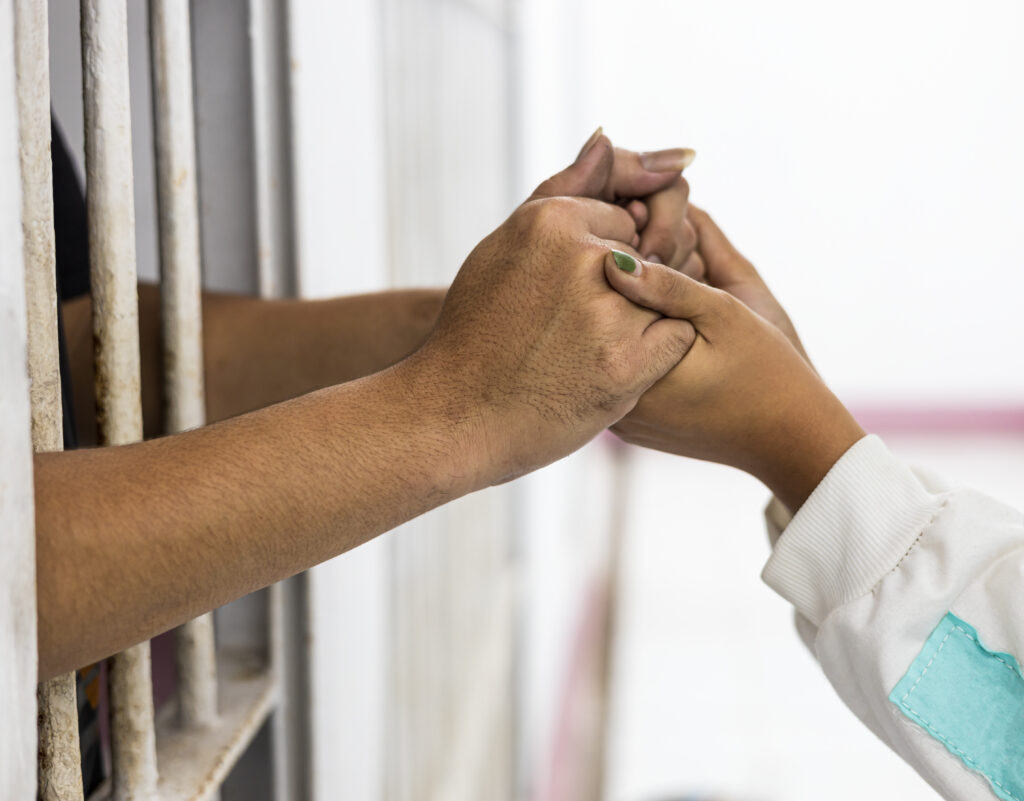
The wife of a falsely convicted Oklahoma man recounts what happened when their communication was cut off in Leflore County Jail.
Leflore County was using the City Telecoin inmate communication service, at the time. At first it seemed like the phones were down. They can be buggy sometimes. After calling the City Telecoin customer service number, they confirmed that nothing was wrong with the phones, or with her husband’s account. They instructed her to call the facility.
When she called the jail staff, she was disappointed, but not surprised.
There’s something nobody is going to tell you about corresponding with an inmate. If, for whatever reason you are unable to answer the phone, or if you are unable to send and receive text messages, it will tell them that you blocked them. It doesn’t matter if it had nothing to do with you, if you’re in a bad cell site, or if the facility rejected you, or if the program is glitching out. Securus, or Telecoin, or Prodigy, whatever you use it doesn’t matter. It will tell your loved one that you blocked them, that you couldn’t accept their call, that you didn’t accept their call. It tells them you’re blocked. You’re rejected without any reason.
A missed phone call might seem like no big deal to most people. With instant messaging, video calls, text, and email being standard fare for almost every platform imaginable, it’s easy to take the phone for granted. How many of us would rather avoid talking on the phone at all? Our young people have grown up with phones in their pockets, and computers on their laps; possessing all the options in the world for using them to connect with other people. It’s only human. We’re social creatures on social media with so much information at our fingertips that having our questions answered, and our messages returned in an instant is almost a given. It’s a sense of security many don’t even know they have.
That is, until it’s gone.
Imagine that, one day, this vast array of resources and connections in front of you is suddenly gone. It’s not gone entirely. Your imagination might already be conjuring images of reaching your phone to the sky, willing it to breathe in a scrap of cell signal, but this isn’t quite that either. This is no bad cell site. It’s not an internet outage. It’s not even one of those annoying content filters your boss or your parents might put on the Wi-fi to keep you off of social media.
What I ask you to imagine, instead, is a sudden and jarring deprivation of all of your freedoms at once, after which you are presented with a single option for each vital thing in your life. Your single option for moving around is limited to the confines of whatever enclosure you’re locked in. Your single option for what to wear is the shabby, ill-fitted outfit you are given. Your single option for what to eat is whatever is slopped in front of you, for what to watch it is whatever is on the tiny television mounted fifteen feet up the wall, for when to sleep and wake it is when the glaring lights are turned on or off, and for how to contact your loved ones it is a single, severely limited platform known as a prison telecom service.
The telecom service is limited by design. Security is the touted virtue of the collection of features offered to the facility, yet in the name of security, a second and possibly more important characteristic is especially prominent: control. Everything is monitored. Everything is subject to approval… and subject to denial. Pictures, messages, phone conversations, and entire contacts may be rejected by the facility, or blocked by the parties who are connected. Some features only work one way. Others impose limits such as truncated messages, or facial detection features that blur everything in a video save a single floating head. Even emojis and direct-to-SMS messages may be banned, requiring users on the outside to download and maintain paid accounts on proprietary apps to stay in contact with loved ones. Communications take considerable, deliberate efforts to maintain; yet they can be easily severed in an instant by the incarcerated person, the account holder outside, or the facility itself, with no warning or explanation.
This is something that my husband and I experienced firsthand in week three. I had mentioned that in the second week I was looking for a job, and trying to get the car back up and running. During that time there was a lot of back and forth where he was trying to communicate with me, I was trying to communicate with him, and give real-time updates. He was giving me ideas, giving me instructions, telling me what I need to do next and what was going to work. Well, that didn’t work out the way we had hoped it would, and it got a little rough there. So we were trying to figure out a way to communicate more reliably, and in the middle of that, we got cut off.
The actual reason for cutting communications might vary. Some families find that services are cut or limited when an incarcerated person is being prepared to move to another facility. Sometimes services remain perfectly intact, but the inmate himself has been physically moved to some secondary location such as a Special Housing Unit (Also known as the SHU, pronounced “Shoe”), or locked down somewhere without access to a tablet or kiosk. Individual communications may be denied at sole discretion of the facility for inappropriate or non-secure content; and entire accounts banned or frozen for the same. Unreliable internet on either end, unexpected software updates, and troublesome glitches in the system are not uncommon, either. Finally, either the incarcerated individual or the account holder outside may block the other party from calling, messaging, or both at any time.
It’s worth noting that, in the event of any kind of block or ban, it’s possible that the individuals involved can be permanently cut off from each other for the remainder of the sentence; even if the block was placed by accident. With no other possible means of communication, it’s no wonder that the threat of a block causes a particular kind of anxiety. To those for whom calls and support from home are a lifeline, continued connection through the telecom is vital.
I just looked down one day, and I noticed he hadn’t messaged me in a while. It said his ability to use Telecoin had been suspended. So I called the facility. I asked why, and Leflore County Jail told me it was because we had some kind of inappropriate interaction and that was the reason they suspended him. Now, we hadn’t really done anything in appropriate. There wasn’t even really any swearing, or anything like that. Regardless, I asked for a reason. They wouldn’t give me one. I pressed the issue, because the way it’s supposed to work is that if for any reason they do deny you the right to communicate, they are supposed to tell you why in writing. It’s not difficult. A text message would do it, or message through Telecoin saying “You were blocked from interaction due to this, that, and the other thing. Okay?” That would be acceptable, but for whatever reason they would not tell me why, and they got very angry with me when I asked them why.
There is legal backing for an expectation of contact between the incarcerated and their families. According to the Oklahoma ACLU, prisoners are afforded a number of legal rights both by state statute and constitutional law. The right to communicate freely with loved ones falls under the 1st Amendment right to freedom of speech. It may only be lawfully censored upon showing good cause, in writing, as to which specific interaction was deemed dangerous or inappropriate, and why. The impulse to “Take up the sword you were cut by,” so to speak, and challenge law enforcement by reminding them of the actual law is tempting, but rarely effective.
I strongly suspect that it was in retaliation; possibly because of videos like this, or because of some things we had issued with as far as him not getting his Medical like he was supposed to. We did end up having a problem with some but not all of the nurses not giving him what he needed. They were really important medicines; basically ones that keep your stomach from destroying you from the inside out. That is a tangent to the point, but not the point. The point is that we were unhappy with them, and they knew it, and I believe that they restricted our communication in response to that. So, for the end of his time there, we were not able to talk to each other.
Fortunately for this couple, when the woman’s husband was transferred out of County Jail he was also transferred to a different telecom company. This meant creating a brand new account on a completely different application, but that in itself was a small price to pay for reopening the lines of communication. Far less fortunately, it also meant that these changes were being navigated while he was in a place called “A & R,” which is short for Assessment and Receiving; in this case, Lexington Assessment and Receiving Center (LARC) the sole State receiving facility for men in the Oklahoma Department of Corrections.
To follow more of this couple’s journey, you can find @OkPrisonWife on YouTube to hear the perspective of loved ones outside, or go this featured article, Getting Transferred to Lexington (LARC) to read about his harrowing experience while being transferred into State custody.